CODE Humpback
This project is a collaboration with SETI Institute scientist Laurance Doyle, who along with colleagues from UC Davis and the Alaska Whale Foundation have used the mathematics of information theory to determine that humpback whale vocalizations have rule-structure complexity, what in human languages is called "syntax." The humpback communication system is an ancient global language - yet we remain effectively alien to each other.
The RCA Morse Code transmitting and receiving stations at Bolinas and Pt. Reyes California are the last of their kind in the U.S. to maintain this once vital maritime language. Thanks to engineers Richard Dillman and Steve Hawes I was able to transmit and receive two messages, 'what are the whales saying?' and 'all we need is love.' Aside from the implied meaning of the prose theses messages become ‘musical’ as morse code. I’ve developed this sonic aspect of the work by converting audio to MIDI, to enable parallel layered expressions of the same ‘idea’ through software instruments and samplers.
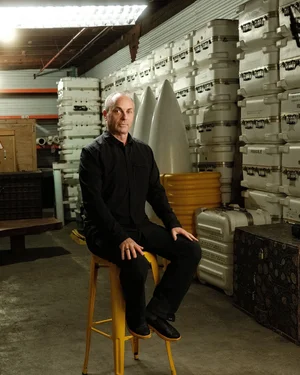
The installation is comprised of hollow metal sculptures based on the scoop shaped air vents of early 20th century ships - an aesthetic that is both functional and also organic, like something from Dr Seuss. Distinct audio/visual content emanates from within each scoop: whale vocalizations, morse code messages and their musical equivalents, field recordings, video of two and three vector ocean surface interference patterns made in the Pacific. The videos becomes clear when the viewer approaches and looks down into each sculpture.
THANKS TO:
Laurance Doyle and the SETI Institute.
Fred Sharpe / Alaska Whale Foundation
Steves Hawes and Richard Dillman at the RCA Bolinas.
Wayne Campbell, Michael Couuts and Ezra Connor - who fabricated the pieces.
Andy Rappaport who helped swap out the video players while I was AWOL
Dave Olsen, Skipper of Moondance
Jennifer Gately, Director of the Bolinas Museum