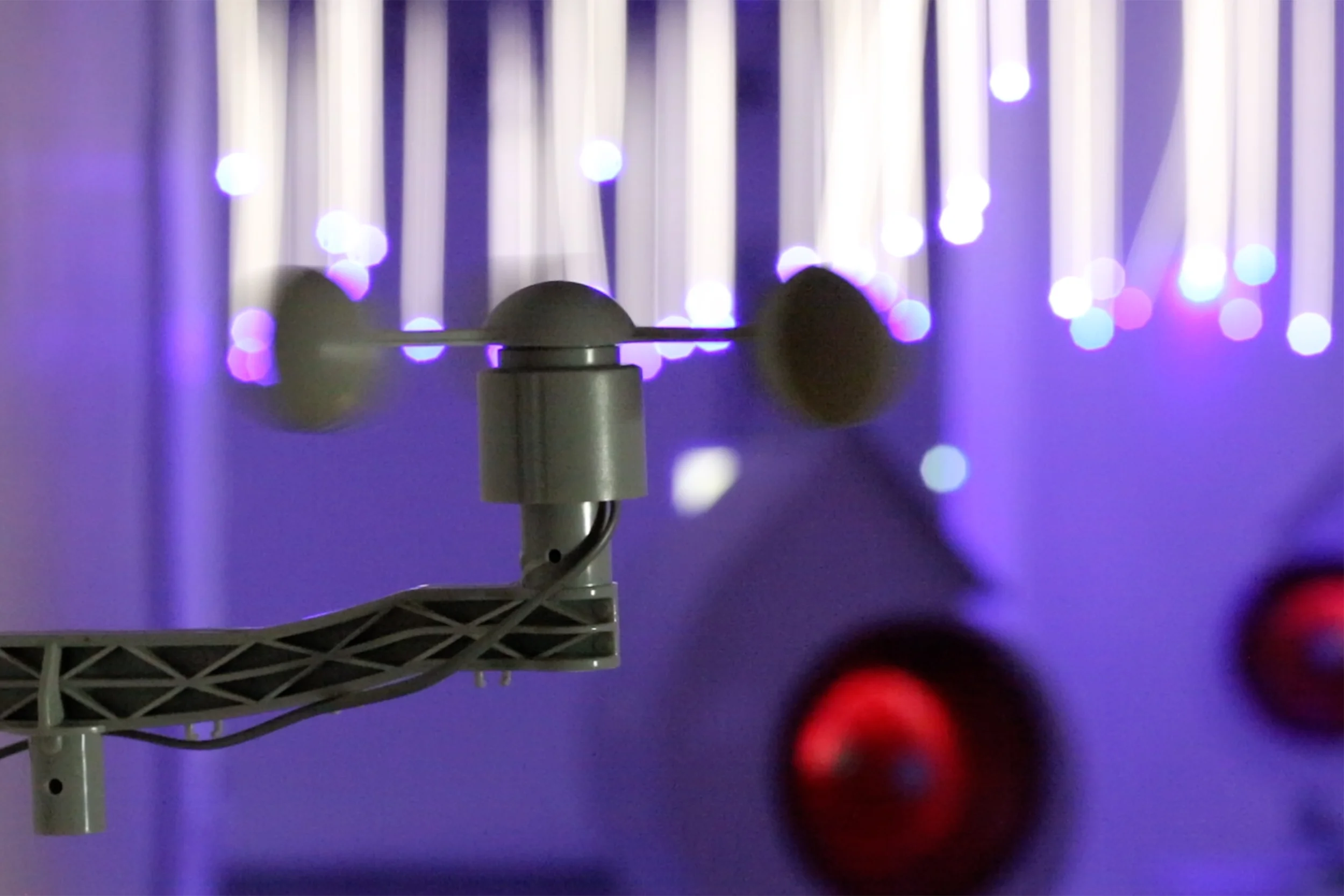
Wind Tunnel: the Hongshan Experiment is a collaborative work realized through partnership with Chinese artist Shaoyu Su. I met Shaoyu at CalArts where he was a graduate student when I lectured there. This installation was commissioned by The Today Art Museum in Beijing as part of the .zip show. It integrates our shared interests in deep time, ancient history, far futures and the phenomena of technology. Wind tunnels are utilized by the aerospace industry to study aerodynamics. Expanding upon my experiments with sound and convolution reverb in the world’s largest wind tunnel at NASA Ames, our wind tunnel is a device for artistic research. Here aural information connects divergent epochs, adding a sonic stratigraphy to the visceral experience. Wind becomes a medium for commentary on what is invisible - a metaphor for the flow of ideas, data, and time itself. In this installation wind also becomes a visceral, haptic medium - literally touching the museum audience.
Future Human, located in the Wind Tunnel's middle chamber, is a CnC sculptural work derived from one of my “CARBON” negatives, which Shaoyu transformed from microscopic data into both ambiguous topography and future artifact.
Future Paradox, located in the third chamber, references the Fermi Paradox. Named after physicist Enrico Fermi, this is the apparent contradiction created by the lack of evidence for extraterrestrial civilizations despite the high statistical probability predicted by astronomers based on the size of the universe. This is a projection mapped space, utilizing two suspended hemispheres, and twelve hacked air purifiers, which were provided by the .zip show sponsor, Xiaomi.
The Hongshan neolithic culture flourished from 4700 - 2900 B.C., leaving behind zoomorphic artifacts in what is now northern China. That wind swept geography and its archeological sites provide source data for the Future Paradox projection maps. Shaoyu merged photogrammetry captured at Hongshan archeological digs with real time wind data from the wind tunnel anemometers to create a spherical map of simultaneous worlds. Current research suggests climate change was responsible for the demise of the Hongshan culture.
Electronic components include seven networked industrial fans, one high voltage control HUB, 12 modified Xiaomi air purifiers, three anemometers, 2 projection hemispheres, 108 suspended flexible laser lights, along with computers and projectors.